
Salmon Creek Directory Holdings
Salmon Creek has no incorporated city government and no separate municipal directory archive. Researchers instead work through Vancouver and Clark County collections, while checking each edition for rural-route and county coverage. The Washington State Library county-directory list confirms five Clark County shelf runs. The county preservation guide then points to libraries, archives, museums, newspapers, and microfilm for editions not shown on that list. Exact holdings differ by repository, so a shelf record is a starting point, not proof that every Salmon Creek household appears.
| Collection | Years | Where Held | Access |
|---|---|---|---|
| Clark County directory shelf | 1918-19, 1921, 1928-29, 1931, 1934 | Washington State Library | Limited appointment access |
| Du Ross and Polk leads | 1907 through selected 1934 editions | State Library and local repositories | Verify each edition |
| Reverse or criss-cross volumes | Local years not confirmed | Library of Congress inventory and local repositories | Request by city, state, and year |
| Vancouver tax ledgers | 1886 and 1891 | WSU and CCGS Digital Collections | Free images and transcripts |
| Clark County census | 1850 and 1885 | Washington Digital Archives | Free index and images |
The confirmed publisher trail includes Harry Du Ross's 1907 Directory of the City of Vancouver and Clarke County and R. L. Polk examples from 1907-08, 1911, 1916, 1918, 1921, 1928-29, 1931, and 1934. That evidence does not establish a continuous run. Ask a repository to confirm the title, year, publisher, format, and county or rural-route scope before planning a visit.
The State Library page is itself a useful finding aid. Its directory holdings appear below, and the image confirms the limited Clark County year list rather than an uninterrupted Salmon Creek city directory series.
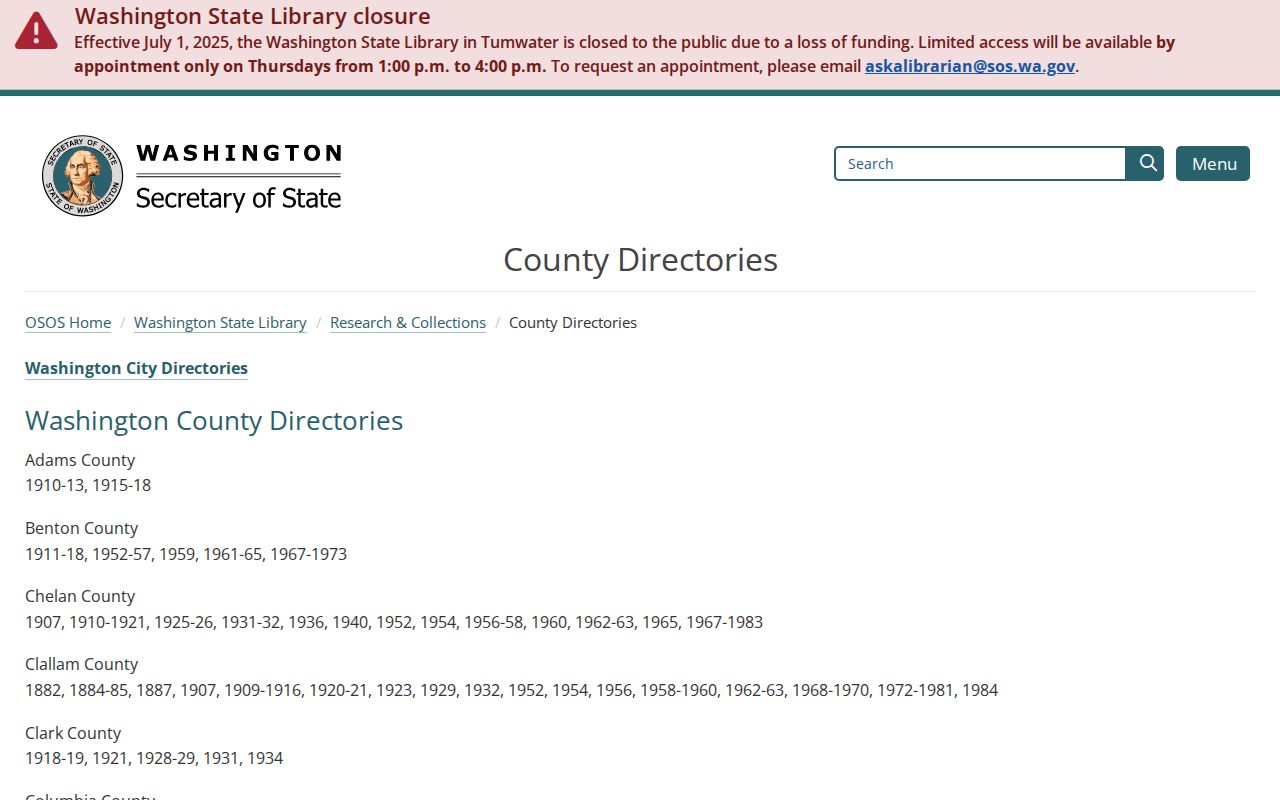
Use the listed year as the request key, then ask whether the volume includes county routes outside Vancouver's incorporated boundary.
Salmon Creek Under Vancouver
A Vancouver mailing label does not settle jurisdiction. Salmon Creek is an unincorporated census-designated place, and many local addresses use Vancouver as their postal city. Historical city directories may organize a household under Vancouver, a named road, or a rural route rather than under Salmon Creek. Search all three forms. Directional marks such as NE and NW also matter because Clark County's street grid distinguishes them.
Copy the entry exactly before modernizing any address. Preserve route numbers, box numbers, old road forms, and abbreviations. Then compare the wording with a period map, plat, deed legal description, or tax ledger. A modern ZIP or street spelling can help locate the place today, but it should not be projected backward as if it appeared in the old volume.
Note: A Vancouver postal line can describe delivery while the parcel remains in unincorporated Clark County.
Salmon Creek Directory Research
The strongest local search combines several counters. Fort Vancouver Regional Libraries genealogy resources include in-library Ancestry Library, FIMO historical maps, HeritageQuest census images and books, Fold3, and multiple newspaper databases. Vancouver Community Library has a microfilm reader. For a shelf question, call FVRL at 360-906-5000 and describe the year, surname, and address form sought.
The Clark County Genealogical Society Library is open to the public and holds an 8,000-item collection with a local focus. It is a practical place to ask about directory editions, family files, maps, and supporting indexes whose details are not exposed online. State Archives Southwest Region is another route for historical county, court, census, land, naturalization, military, and cemetery series.
The CCGS holdings page shown below documents that public local-history route. Contact staff before a trip because repository hours, access rules, and exact shelf locations can change.
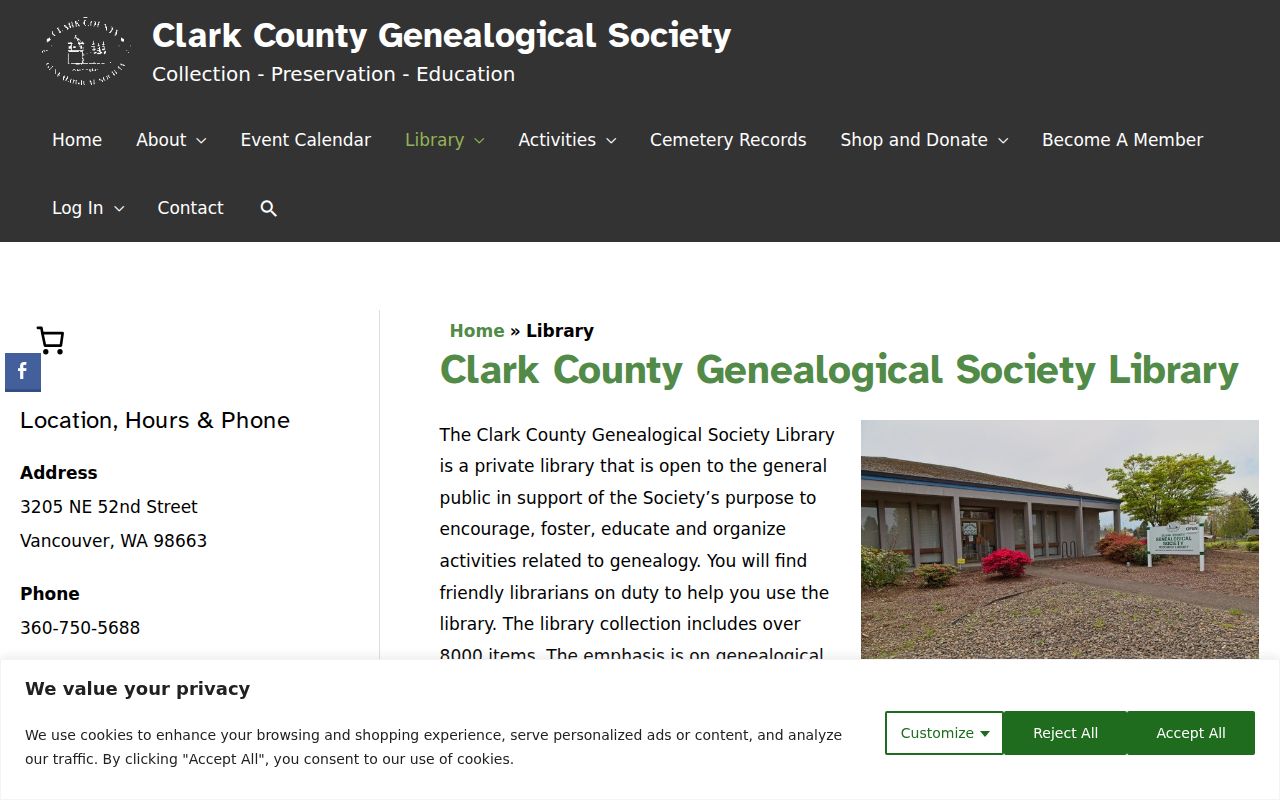
Repository staff can help separate a directory title from a tax roll, phone book, yearbook, or manuscript index.
Digital Records Beside Directories
No official public viewer exposed an actual Salmon Creek directory page during the research. Two digitized Vancouver tax ledgers provide a sound substitute for a different question: who was tied to a city lot and assessed value in 1886 or 1891. The WSU and CCGS collection offers page images plus PDF and spreadsheet transcripts. It must be labeled as a tax ledger, not a city directory.
That distinction matters. A directory publisher gathered names and addresses for an edition. A tax ledger records assessed property by name, lot, block, and value. The two can corroborate each other, but neither should be made to say what only the other records.
The digitized collection pictured below shows how the ledger images and transcripts are presented.
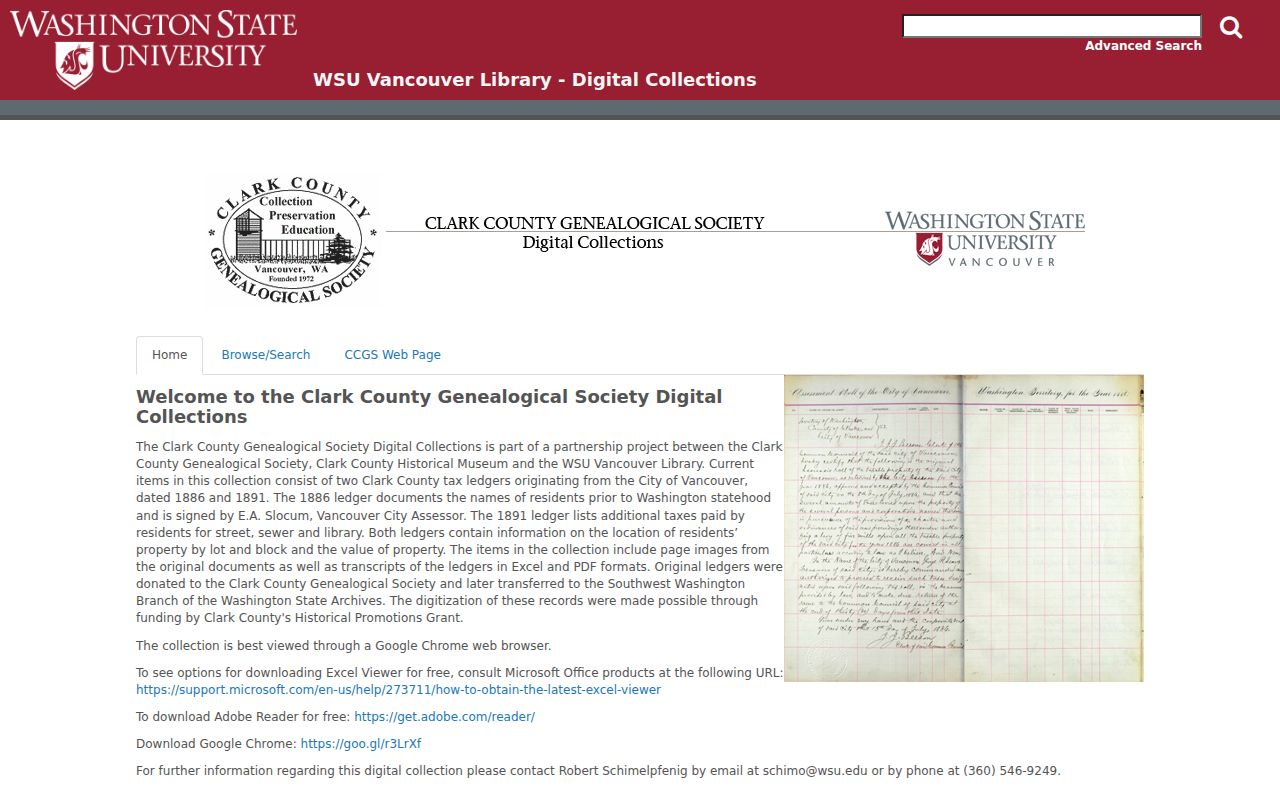
Reconcile a ledger lot and block with a plat or later deed before connecting it to a present Salmon Creek address.
Read a Salmon Creek Directory Entry
Begin with the alphabetical entry and transcribe every mark. A surname and initials may be followed by a spouse, relationship, trade, employer, house number, street, rural route, box, or phone. Later editions may add telephone numbers. Some people are absent because they were unlisted, had no phone, lived beyond the compiler's scope, or appeared under a different name form.
| Name | Surname first, then given name or initials; a spouse may appear in parentheses. |
|---|---|
| Work or role | A trade, employer, business, or public role may help separate people with the same name. |
| Address | House and street, room, rural route, or box as the publisher printed it. |
| Phone | Present in some later editions; absence does not prove the household was gone. |
| Status notation | Widow or relationship wording can link one edition to death, marriage, or probate records. |
- Criss-cross directory
- A listing arranged by street and house number instead of by a person's surname.
- Householder index
- A section that groups the listed person or household under an address.
- Abbreviation key
- The edition's own guide to short forms and symbols, often printed near the front.
Do not assume that “r,” “h,” or another mark means the same thing in every edition. Photograph or copy the volume's own abbreviation key first. A claimed owner marker also needs confirmation in a deed or tax record. The directory entry is evidence of what the compiler reported, not a certified statement of title or continuous residence.
Salmon Creek Directory Genealogy
FVRL's online research menu is the bridge from one directory hit to a fuller identity. HeritageQuest provides federal census images from 1790 through 1950 and a large family-history book collection. Ancestry Library adds directories, yearbooks, vital, military, immigration, maps, and newspapers, but it is available only inside the library. FIMO can compare fire-insurance maps and atlases, while Fold3 supports military and naturalization work.
The library's newspaper products overlap rather than duplicate one another. NewsBank lists The Columbian from May 26, 1994 through April 29, 2024, while ProQuest lists it from January 1, 1995 through February 3, 2024. Search both when a directory trail ends in the modern era. Dates and indexing differ.
The FVRL page pictured here identifies the genealogy databases and their access limits.
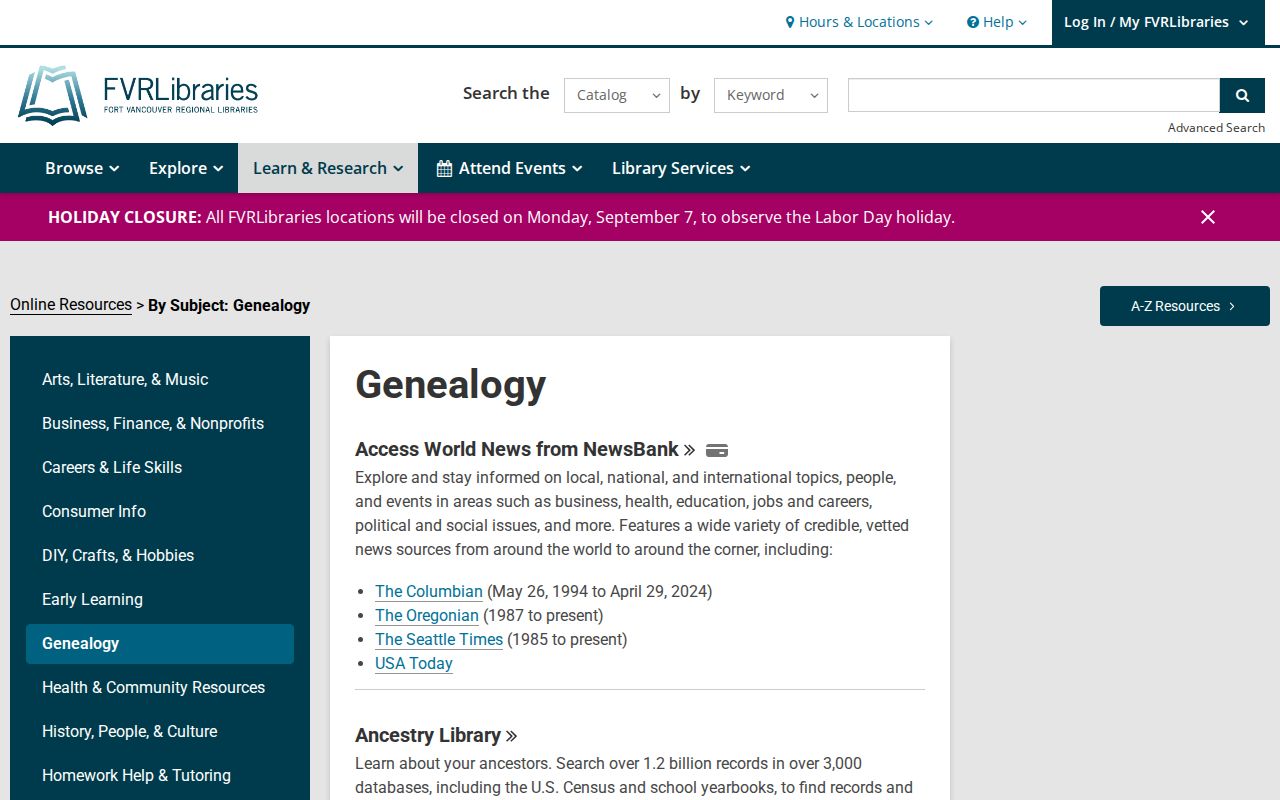
A library card or an in-library session may be required, so check access terms before searching from home.
Clark County Directory Timeline
The local record sequence is uneven, but its dated landmarks show which source can bridge the next gap. Treat each year as a verified point, not as the endpoint of a complete series.
- 1850: Clark County census index and images place people in households before the confirmed directory editions.
- 1885: The territorial census adds another household snapshot in Washington Digital Archives.
- 1886 and 1891: Vancouver tax ledgers connect assessed names to lot, block, and value.
- 1907: Harry Du Ross published a Vancouver and Clarke County directory; Polk examples begin in the same era.
- 1918-1934: The State Library confirms selected Clark County directory holdings across five shelf entries.
Clark County's 1890 courthouse fire destroyed most early county records. That makes the 1880s ledgers, census images, church records, newspapers, cemetery sources, and later deeds especially important. A missing courthouse file is not proof that an event or household did not exist.
Trace Salmon Creek Directory Families
A city directory becomes more useful when each edition is treated as one dated observation. Start with a known name and keep a research log that records the exact title, year, page, spelling, address, and any spouse or role. Then test each detail against a source created for a different purpose. That method reduces false matches between people who share a surname and initials.
- Search surname variants and initials in the alphabetical section, then copy the entry as printed.
- Check nearby editions and note address, relationship, and name changes instead of assuming a gap means a move.
- If the edition has a street guide, inspect the house number and nearby entries for household context.
- Compare the result with the 1850 or 1885 Clark County census and the released federal census years through 1950.
- Bridge remaining gaps with deeds, voter lists, marriages, deaths, probate, newspapers, yearbooks, and cemetery records.
Disappearance has several possible causes: death, a move, a name change, a missing edition, an unlisted phone, or a compiler boundary that excluded a rural route. Search the address as well as the name. An obituary or death register may explain a final appearance, while a deed or later census can reveal that the family remained nearby under a different address form.
Keep the source boundary clear. Historical directory research should not be used to expose a protected or current private address.
Limits of Salmon Creek Directories
No verified source supplied a complete Salmon Creek household roster, a complete Clark County directory run, or confirmed local criss-cross years. A directory may omit children, boarders, people without a listed phone, short-term residents, households outside the publisher's route, and anyone indexed under an unexpected name. Rural Salmon Creek coverage must be checked edition by edition.
Publication year is not always the date on which the information was gathered. A name at an address shows that the publisher associated them for that edition. It does not prove ownership, exact move dates, or presence for all twelve months. Use the Salmon Creek previous residents search when the goal is a backward address trail built from deeds and dated occupancy clues.
For an unlisted holding, call or email the named repository. Supply the title or publisher, year, surname, address form, and desired format. Ask whether staff can check an index, whether a reading-room appointment is needed, and whether copying is permitted. This fallback is more reliable than assuming an online catalog is complete.